Quarantine Resettlement Program
World War ZThe Quarantine Resettlement Program was the Cuban government’s principal framework for receiving, containing, and managing the human influx created by the undead crisis. Officially designed to prevent infection from spreading, it placed roughly five million American refugees, together with arrivals from Latin America, Africa, and Western Europe, under state jurisdiction. Its decisive significance lies in its double function: it treated displaced people as a biological danger and a labor reserve, yet the very process intended to preserve the existing order helped produce the social and economic transformation that followed.
Origins and Purpose
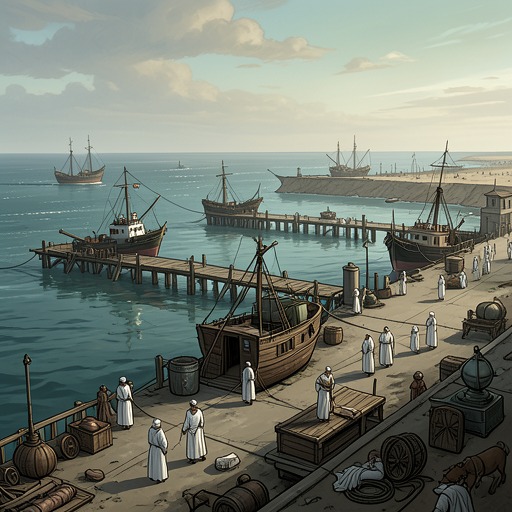
Cuba’s geography prevented the large overland swarms that devastated many other countries, but it did not make the island secure. The principal threat arrived by sea in an armada of boat people, bringing both contagion and ambitious human invaders who imagined themselves as modern conquistadors. The experience of the smaller Windward and Leeward Islands, whose inhabitants first suppressed local outbreaks and then repelled seaborne undead and refugees, gave Cuba time to decide the terms on which outsiders would be admitted. Sanctuary would be offered under Cuban rules rather than as an unrestricted right of entry.
The refugee population grew through every available maritime route. People arrived on large ships, private craft, and homemade rafts, and the majority came from the United States. Their total eventually reached five million, almost half the size of Cuba’s indigenous population. Other arrivals included people from mainland Latin America, Africa, Spain, Canada, and elsewhere in Western Europe. The program therefore responded not to a narrow border incident but to a demographic shock capable of overwhelming the island’s institutions, coastline, and political balance.
The program’s public justification was quarantine. The Cuban authorities presented the camps as a barrier against the infection carried by refugees, though the program also served broader purposes of surveillance, political control, and economic mobilization. The distinction between medical containment and social management was deliberately blurred: the same institution that isolated newcomers from the population also determined where they lived, how they worked, and how quickly they could regain freedom.
Camp Conditions and Labor Regime
The Resettlement Centers were harsh, though the Cuban account distinguishes them from prison camps for political dissidents. Refugees were initially assigned to agricultural labor regardless of their prewar occupation or social status. They worked twelve to fourteen hours a day as field hands, growing vegetables on former state-run sugar plantations. Their unfamiliarity with the work did not exempt them from it; professional identity, wealth, and former status had little immediate value inside the emergency system.
The climate offered some relief as temperatures fell and skies darkened, conditions that made survival more plausible for people facing the broader undead threat. The guards, however, were openly coercive. They answered complaints with slaps, kicks, and warnings that continued disobedience would result in being thrown to the zombies. Such threats were reinforced by rumors of “zombie pits,” supposedly boiling lakes of undead into which troublemakers were lowered headfirst. The General Intelligence Directorate planted prisoners among the general population to circulate these stories. The pits were not real, but the rumor was an administrative instrument: fear accomplished what guards and walls could not always guarantee.
The program thus combined quarantine with a disciplinary labor system. The refugees were protected from the immediate dangers outside the centers, but that protection came with forced work, restricted movement, violence, and the suspension of ordinary expectations about wages, occupation, and civil status. They were neither simply welcomed immigrants nor ordinary prisoners. They were people held inside an emergency order whose usefulness was measured in labor, obedience, and the absence of infection.
Security, Manpower, and Dissolution
The system could not be maintained indefinitely. Cuba lacked enough personnel to guard five million detainees while also defending almost four thousand kilometers of coastline and fighting the Yankee invasion. The government could not sustain a two-front war: one against external military forces and another against the population confined in the centers. The camps therefore became a liability as well as a mechanism of control.
The solution was to dissolve the centers gradually through a specialized parole arrangement. Ten percent of the Yankee detainees were permitted to work outside the wire. They filled jobs that Cubans no longer wanted, including day labor, dishwashing, and street cleaning. Their wages were nearly worthless in ordinary terms, but their labor hours accumulated points that could be exchanged for the release of other detainees. This converted freedom into a measurable commodity and made the detainees’ labor directly responsible for expanding the program’s own dismantling.
The arrangement was described as an ingenious idea devised by a Florida Cubano. At first the government attempted to keep track of everyone released into outside employment, but that effort quickly became impossible. Within a year, the former camp population had almost entirely integrated into Cuban society as Nortecubanos. A system created to isolate foreigners had thereby become a mechanism for dispersing them through the island’s workplaces, neighborhoods, and institutions.
Integration and Political Consequences
The program’s consequences exceeded its official purpose. The infection it was built to contain was not only the biological spread associated with the dead. Another, less visible infection entered Cuban life: new habits of speech, economic expectations, private enterprise, and political imagination. At first these changes remained behind closed doors and were expressed in whispers. Over the following years, however, an economic reform here and a legalized privately owned newspaper there allowed people to think and speak more boldly.
This evolution was not presented as a single revolution. It was gradual, quiet, and cumulative. The resettled population brought experiences and assumptions from societies outside Cuba’s established political structure, while the state’s need for their labor created opportunities it could not indefinitely police. Once the camps were drained and the Nortecubanos had entered ordinary social life, the boundaries that quarantine had attempted to preserve became increasingly difficult to enforce.
The program therefore reveals the instability of emergency governance. Its administrators sought to preserve sovereignty through exclusion, compulsory labor, threats, and controlled release. Yet the same measures exposed the limits of the state’s manpower and made outsiders economically indispensable. The resulting integration weakened the isolation on which the old order depended, helping prepare the ground for broader reform when international events later shifted in Cuba’s favor.
Narrative and Political Significance
The Quarantine Resettlement Program illustrates how a state can turn migration into a question of biological security, labor allocation, and political legitimacy at once. Refugees were screened and confined because they were said to carry infection, but they were also exploited because their labor was needed. Their legal and social identity remained provisional: they were under government jurisdiction, constrained by the camps, and granted freedom through a points system rather than by an ordinary process of citizenship.
Its structure also dramatizes the tension between coercion and consent. The program began with guards, threats, fabricated rumors, and forced agricultural work. It ended with former detainees circulating through Cuban society and becoming part of its productive life. The transition was not humane in method, and it did not erase the violence of detention, but it demonstrates that emergency institutions can produce consequences their designers neither intend nor control.
In the wider history of the war, the program stands as a model of quarantine that became resettlement, resettlement that became labor policy, and labor policy that became an engine of social change. Cuba survived the immediate danger by controlling who could enter and under what conditions. It then discovered that containment could not prevent transformation: the people held behind the wire eventually helped change the society that had confined them.